 EN
EN

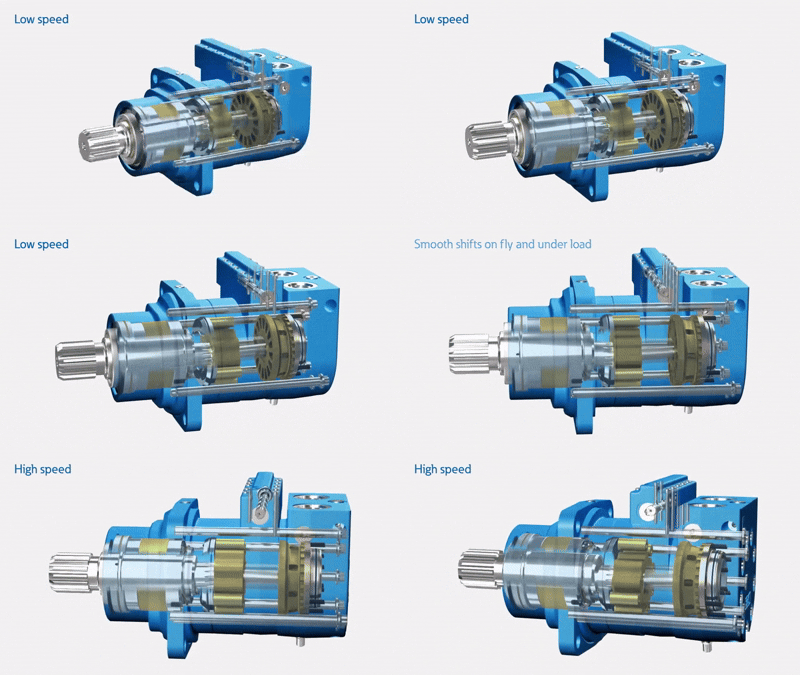
In a previous article, we discussed hydraulic pump systems and their overall working principle. To briefly recap, a hydraulic system is a drive technology that transmits energy using fluid as a medium. It converts the mechanical energy of an electric motor into liquid energy, which is then transmitted to the executive components through the liquid. The main components of a hydraulic system include hydraulic pumps, executive components (hydraulic motors), valves, and oil tanks.
This article will focus on hydraulic pumps and hydraulic motors, and explain how they work together in a hydraulic system. We will start with the hydraulic pump.
Classification of Hydraulic Motors
Hydraulic motors are generally divided into two major categories:
Low-Speed High-Torque (LSHT) Hydraulic Motors
High-Speed Low-Torque (HSLT) Hydraulic Motors
Choosing a low-speed hydraulic motor allows the system to output higher torque at lower speeds. Within these two categories, they can be further classified by structure into gear motors, vane motors, and piston motors. Piston motors can be further subdivided into axial piston motors and radial piston motors.
Classification of Hydraulic Pumps
Common types of hydraulic pumps include:
1. By flow adjustment capability:
Variable pumps — Output flow can be adjusted as needed
Fixed displacement pumps — Output flow is constant
2. By structure: Gear pumps, Vane pumps, Piston pumps
Gear pumps: Small in size, simple in structure, low requirement for oil cleanliness, and low cost; however, the pump shaft is greatly affected by unbalanced forces, suffers severe wear, and has a large leakage volume.
Vane pumps: Can be divided into single-acting and double-acting types. They have uniform flow, smooth operation, low noise, and higher pressure and volumetric efficiency compared to gear pumps, but their structure is more complex than that of gear pumps.
Piston pumps: High volumetric efficiency, low leakage, and can operate under high pressure, making them suitable for large-power hydraulic systems. However, they have a complex structure, high requirements for materials and machining accuracy, high cost, and also have high requirements for oil cleanliness.
Composition of Hydraulic Pumps
Hydraulic pumps are generally composed of three main parts: couplings, hydraulic oil tanks, and filters.
Couplings
The drive shaft of a hydraulic pump cannot withstand radial or axial forces, so it is not allowed to directly install pulleys, gears, or sprockets on the end of the shaft. Typically, the drive shaft is connected to the pump drive shaft through a coupling.
If, due to manufacturing reasons, the coaxiality of the pump and the coupling exceeds the standard, and there is a deviation during assembly, as the pump speed increases, the centrifugal force will increase, which may cause the coupling to deform. This deformation further increases the centrifugal force, creating a vicious cycle, ultimately leading to vibration and noise, which affects the service life of the pump. In addition, factors such as loose coupling pins and worn rubber rings that are not replaced in time will also affect the operation of the pump.
Hydraulic Oil Tank
The main functions of the hydraulic oil tank in a hydraulic system are: to store oil, dissipate heat, separate air contained in the oil, and eliminate foam.
When selecting an oil tank, the first consideration is its capacity: for mobile equipment, it is generally 2-3 times the maximum flow rate of the pump, and for fixed equipment, it is 3-4 times. Second, consider the oil level of the oil tank: when all hydraulic cylinders of the system are fully extended, the oil level in the oil tank must not be below the minimum oil level; when the cylinders retract, the oil level must not exceed the maximum oil level. Finally, consider the structure of the oil tank: the baffles in traditional oil tanks cannot effectively precipitate dirt, so a vertical baffle should be installed along the longitudinal axis of the oil tank. There should be a gap between this baffle and the end plate of the oil tank, allowing the spaces on both sides of the baffle to communicate. The inlet and outlet ports of the hydraulic pump are arranged on the end of the baffle that is not connected, making the distance between the inlet and return oil as far as possible. At the same time, the oil tank can also better dissipate heat.
Oil Filter
Generally, contaminants with a particle size of less than 10 μm have little effect on the pump, but when the particle size is greater than 10 μm, especially exceeding 40 μm, it will significantly affect the service life of the pump. Solid contaminant particles in hydraulic oil are prone to accelerate wear on the surfaces of relatively moving parts inside the pump. Therefore, an oil filter must be installed to reduce the degree of oil contamination. The recommended filtration accuracy is as follows: 10~15 μm for axial piston pumps, 25 μm for vane pumps, and 40 μm for gear pumps. Using high-precision oil filters can greatly extend the service life of hydraulic pumps.
The Function of Hydraulic Motors
A hydraulic motor is an actuating element that converts the pressure energy of a liquid into mechanical energy, outputting torque and rotational motion, and holds an important position in hydraulic systems.
Hydraulic motors are generally divided into two types: low-torque and high-torque. In recent years, with the continuous development of hydraulic technology towards high pressure and high power, and as people pay increasing attention to environmental protection, hydraulic actuators are required to have characteristics such as low noise, low pollution, and smooth operation. Therefore, high-torque motors have become one of the development trends.
From the perspective of energy conversion, hydraulic pumps and hydraulic motors are reversible hydraulic components: inputting working fluid to any hydraulic pump can convert it into a hydraulic motor operating condition; conversely, when the main shaft of the hydraulic motor is rotated by an external torque, it can also be converted into a hydraulic pump operating condition. This is because they have the same basic structural elements: a sealable and periodically variable volume and the corresponding oil distribution mechanism.
The Role of Hydraulic Pumps in Hydraulic Systems
Simply put, a hydraulic pump is a device that converts mechanical energy into hydraulic energy. Hydraulic transmission systems use different types of hydraulic pumps to overcome loads and achieve power output.
For example, in hydraulic drive systems like excavators, the hydraulic pump is responsible for providing the pressure needed to lift vehicles or heavy objects. Most heavy construction machinery is equipped with hydraulic pumps, which are core components of hydraulic systems.
In addition to large equipment, there are also smaller hydraulic pumps used to power various hydraulic tools, such as cutting tools, presses, hydraulic saws, etc. These tools all rely on hydraulic pumps to operate efficiently.
Differences Between Hydraulic Pumps and Ordinary Pumps
The biggest difference between hydraulic pumps and ordinary pumps lies in their working methods. Ordinary pumps typically maintain a constant flow of liquid, while the flow rate of hydraulic pumps is closely related to the load pressure.
Furthermore, their functions are different: hydraulic pumps must overcome the pressure generated by the system load, whereas ordinary pumps are only responsible for continuously conveying or circulating liquid.
The Function of a Hydraulic Motor
A hydraulic motor is a rotational actuating component, also known as a rotary actuator. Its main function is to convert hydraulic energy into mechanical energy to drive the load to move.
The output power of a hydraulic motor is determined by the pressure drop and flow rate of the hydraulic oil. In other words, the output power of a hydraulic motor is directly proportional to its rotational speed.
The Collaborative Working Principle of Hydraulic Pumps and Hydraulic Motors
After understanding the functions of hydraulic pumps and hydraulic motors, let's look at how they work together in a system:
First, the hydraulic pump converts mechanical energy from a prime mover (such as an electric motor or diesel engine) into hydraulic energy, which exists in the form of flowing hydraulic oil.
Subsequently, the hydraulic motor receives the hydraulic energy generated by the hydraulic pump and converts it back into mechanical energy, which is used to drive the load to perform work.
After this conversion process is completed by the hydraulic motor, the entire system has the mechanical energy required to perform tasks. Hydraulic systems are widely used in our daily lives; for example, elevators, fuel dispensers, and amusement facilities all rely on the collaborative action of hydraulic pumps and hydraulic motors.
Frequently Asked Questions (FAQ)
1. What is the difference between a hydraulic pump and a hydraulic motor?
Answer: A hydraulic pump converts mechanical energy into hydraulic energy (pressurized fluid), while a hydraulic motor converts hydraulic energy back into mechanical energy (torque and rotational motion).
2. What are the main types of hydraulic motors?
Answer: Hydraulic motors are mainly divided into two categories:
Low-Speed High-Torque (LSHT) Motors
High-Speed Low-Torque (HSLT) Motors
In addition, by structure, they include gear motors, vane motors, and piston motors (including axial and radial piston types).
3. What are the common types of hydraulic pumps and their classification methods?
Answer: Hydraulic pumps are commonly classified in the following two ways:
Flow adjustability: Variable pumps (adjustable) and fixed pumps (constant flow)
Structural type: Gear pumps, vane pumps, piston pumps.
Gear pumps: Small size, simple structure, low cost, but high wear and leakage.
Vane pumps: Uniform flow, smooth operation, low noise, higher efficiency than gear pumps, but complex structure.
Piston pumps: High volumetric efficiency, low leakage, can operate at high pressure, suitable for high-power systems, but high cost and high requirements for oil cleanliness.
4. What are the components of a hydraulic pump system?
Answer: A hydraulic pump system generally includes:
Coupling (connecting the drive shaft and pump shaft)
Hydraulic oil tank (storing oil, dissipating heat, separating air, and eliminating foam)
Filter (reducing solid contaminant particles in the oil)
To ensure system reliability, it is necessary to ensure proper alignment of the coupling, appropriate capacity and structure of the oil tank, and selection of filters with the correct precision.
5. What role does a hydraulic motor play in the system?
Answer: A hydraulic motor receives pressurized liquid, converts hydraulic energy into mechanical energy, and outputs torque and rotational motion. Its output power depends on the pressure drop of the liquid and the flow rate, so when the flow rate or pressure changes, the motor's output will change accordingly.
6. How do hydraulic pumps and hydraulic motors work together?
Answer: In a hydraulic system:
The hydraulic pump converts the mechanical energy provided by the prime mover (such as an electric motor or diesel engine) into liquid energy.
The hydraulic motor receives this pressurized liquid and converts it back into mechanical energy to drive the load.
Through this energy conversion, the system can achieve the required mechanical output.
7. Why is the cleanliness of oil and filtration so crucial in hydraulic systems?
Answer: Solid particles in hydraulic oil (especially those larger than 10 μm, particularly larger than 40 μm) can exacerbate wear on internal components of pumps and motors, reducing efficiency and lifespan. Installing filters with appropriate precision (e.g., 10-15 μm for axial piston pumps, 25 μm for vane pumps, 40 μm for gear pumps) can effectively maintain system reliability.
8. If my hydraulic pump is making noise or vibrating, what should I check?
Answer: Common causes include:
- Misalignment between the pump and coupling/shaft
- Speed or load exceeding rated values
- Air intake or cavitation in the suction line
- Poor oil cleanliness or incorrect oil quantity/type
- Wear or damage to coupling or internal pump components
Addressing these issues helps reduce noise, vibration, and extend pump life.
9. Does a hydraulic pump \"generate\" pressure in the system?
Answer: Actually, not entirely. The primary function of a hydraulic pump is to produce flow; pressure is formed only when this flow encounters resistance in the system (such as load, valves, or actuators). Therefore, it is inaccurate to attribute pressure generation solely to the pump.
10. What efficiency metrics are there for hydraulic pumps and motors?
Answer: Key efficiency metrics include:
- Volumetric efficiency: Actual flow ÷ Theoretical flow
- Mechanical/Hydraulic efficiency: Theoretical torque ÷ Actual torque (or related to mechanical losses)
- Overall efficiency: Volumetric efficiency × Mechanical/Hydraulic efficiency