 EN
EN

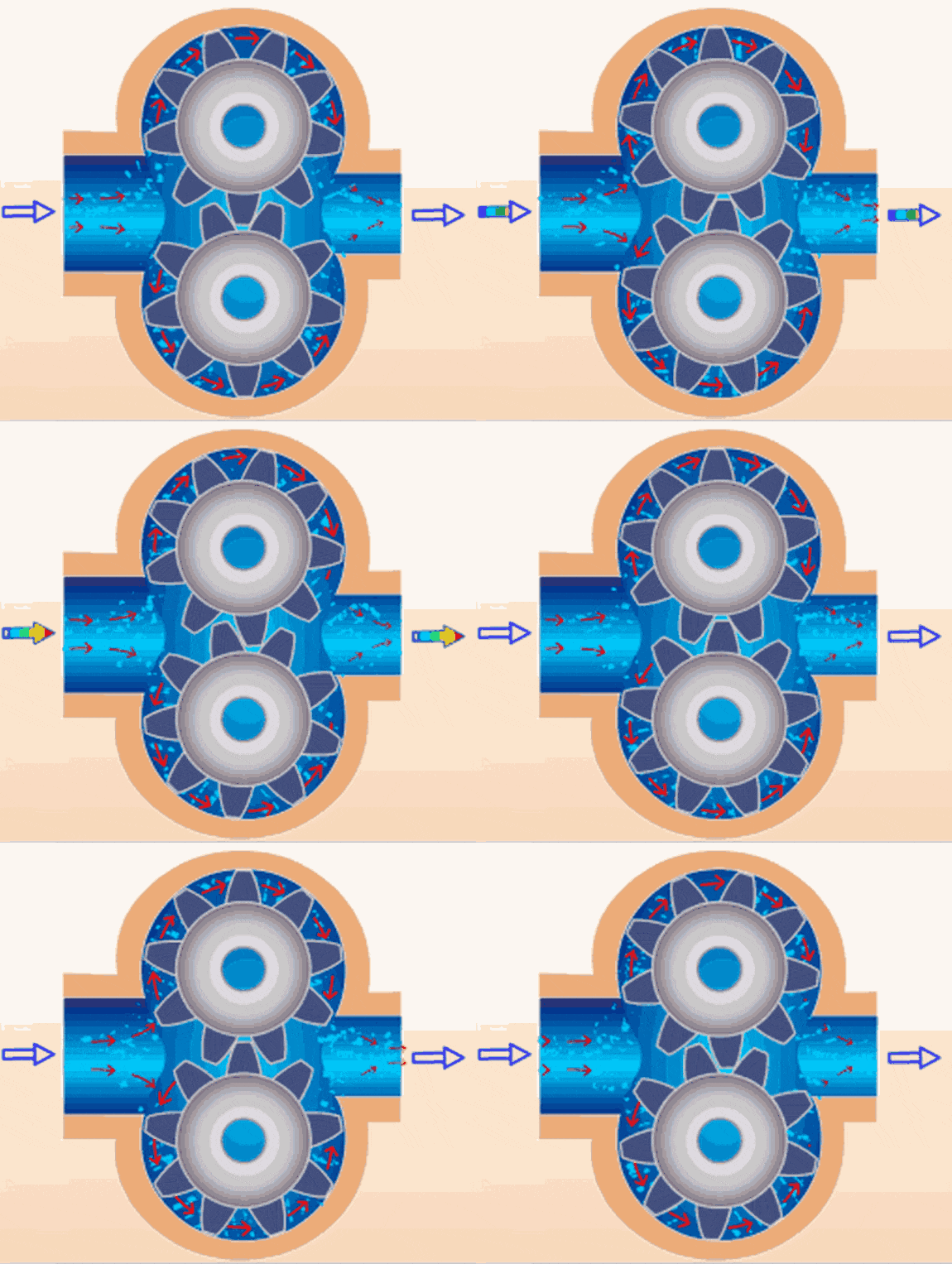
In hydraulic systems, gear pumps are widely used in engineering machinery, agricultural machinery, and industrial hydraulic equipment due to their simple structure, high reliability, and convenient maintenance. However, in the actual process of selection and application, many people do not truly distinguish the working characteristics of internal gear pumps and external gear pumps. They often make decisions based on experience or price alone, ultimately leading to problems such as high noise, low efficiency, and short service life.
To select the right type, it is first necessary to understand the essential differences between these two types of pumps from multiple dimensions, including structural principles, flow characteristics, noise performance, operating condition adaptability, and application scenarios.
I. Fundamental Difference: Structure Determines Everything
At its core, the difference between internal and external gear pumps stems from different gear meshing methods, and the meshing method directly determines the continuity and smoothness of oil delivery.
External Gear Pump
An external gear pump consists of two gears of the same size, which mesh with each other on the outer side inside the pump body. As the gears rotate, a negative pressure is formed on the side where the gears disengage, drawing oil into the suction port. The oil is then carried along the space between the outer circumference of the gears and the pump housing, and is finally squeezed out through the discharge port when the gears re-engage on the other side.
The main characteristics of this structure are:
- Clear force transmission path
- Fewer number of parts
- Low processing and assembly difficulty
However, due to the relatively direct gear meshing process, there is a noticeable volumetric change in the oil during transportation.
Internal Gear Pump
An internal gear pump, on the other hand, consists of an internal gear and an external gear. The internal gear rotates eccentrically inside the external gear. The oil is enclosed in the oil chamber formed between the teeth of the internal and external gears, and is continuously and smoothly transported to the outlet as the gears rotate.
Compared to the external gear structure, internal gear pumps have:
- More continuous meshing
- More gradual changes in the oil chamber
- A more stable oil delivery process
This is also the fundamental reason why internal gear pumps have greater advantages in terms of smoothness and noise control.
II. Flow Pulsation: Determining System 'Stability'
In hydraulic systems, flow pulsation is a major cause of vibration, noise, and temperature rise.
Flow Characteristics of External Gear Pumps
Due to the significant changes in oil chamber volume when gears engage and disengage in external gear pumps, the output flow exhibits periodic fluctuations. Such pulsations are more pronounced under high-speed or high-load operating conditions.
Practical Manifestations:
- Excessive system vibration
-明显的 pipeline noise
- Greater impact on valves and seals
Flow Characteristics of Internal Gear Pumps
Internal gear pumps have more continuous oil chamber changes, with oil being 'enveloped' and transported between teeth, resulting in more uniform flow output. This structure can significantly reduce flow pulsation.
Practical Manifestations:
- More stable system operation
- Smaller pressure fluctuations
- More favorable for hydraulic components
III. Noise and Comfort Differences
Noise issues are often not \"the pump is broken\", but rather a mismatch in pump type.
External Gear Pump
The gear meshing impact is direct, resulting in noticeable flow pulsation and relatively high noise levels. However, it is fully acceptable in equipment with high noise tolerance such as engineering machinery and agricultural machinery.
Internal Gear Pump
The meshing is smooth and the oil flow is continuous, resulting in significantly lower noise. It is particularly suitable for industrial equipment, indoor systems, or applications with higher comfort requirements.
IV. Adaptability to Hydraulic Oil and Operating Conditions
External Gear Pump
Better suited for hydraulic oils with higher cleanliness.
Relatively sensitive to changes in oil viscosity.
Wear speed will increase when the oil is severely contaminated or lubrication conditions are poor.
Internal Gear Pump
Has a wider adaptability range to oil viscosity.
Performs more stably in high-viscosity oil or lubrication-oriented operating conditions.
More friendly to oil film formation conditions.
V. Efficiency, Lifespan, and Maintenance Cost
From a long-term operation perspective:
External Gear Pump
It has low initial cost and simple maintenance, but in high-demand systems, vibration and wear may shorten the overall lifespan.
Internal Gear Pump
It has a higher initial investment, but operates smoothly with uniform wear, which is more conducive to long-term continuous operation.
VI. Comparison of Typical Application Scenarios
Common Applications of External Gear Pumps
Agricultural Machinery
Construction Machinery
Vehicle Hydraulic Systems
Cost-sensitive General Hydraulic Equipment
Common Applications of Internal Gear Pumps
Industrial Hydraulic Systems
Lubrication Systems
Precision Equipment
Scenarios with High Requirements for Noise and Stability
VII. Core Logic of Engineering Selection
In engineering practice, there is no such thing as a 'more advanced pump,' only a 'more suitable pump.'
If the system prioritizes cost-effectiveness, simple structure, and easy maintenance → select an external gear pump.
If the system prioritizes smooth operation, low noise, and long-term continuous operation → select an internal gear pump.
If the selection is mismatched, even the most expensive pump may perform poorly.
VIII. Engineer's One-Sentence Summary
The difference between gear pumps lies not in their names, but in their structures; ultimately, structural differences are reflected in system performance.